Our Location
304 North Cardinal St.
Dorchester Center, MA 02124

304 North Cardinal St.
Dorchester Center, MA 02124

Learn what causes a broken weld, how to inspect the failure, repair it correctly, and prevent the same weld from breaking again.

A broken weld does not always mean the welder did a bad job. Sometimes the weld itself fails. Sometimes the crack starts beside it. And sometimes the joint simply sees more load than it was designed to handle.
That distinction matters before any repair begins. Dynalasers handheld laser welding systems can be useful for thin-metal repair where heat control and filler delivery matter, but no welding process can compensate for a joint that has not been properly assessed first.

In simple terms, a broken weld is a welded joint that has cracked or separated enough to lose part of its intended strength.
The fracture does not have to run through the middle of the bead. It may follow the fusion line, start at the toe, move through the heat-affected zone, or tear into the base metal.
That is why the phrase “the weld broke” can be misleading.
A small weld crack is also worth taking seriously. Under vibration or repeated loading, it may continue growing until the joint finally lets go.

There is rarely one universal answer. The condition of the metal before welding, the amount of fusion achieved, the filler, heat input, joint geometry, and service load can all play a part.
Rust, scale, paint, oil, and moisture are easy to underestimate.
They may interfere with fusion or introduce porosity and other welding defects. The finished bead can still look reasonable from the outside, especially if the problem is below the surface.
Good preparation is not extra work. It is part of making the weld.
Need a cleaner surface before welding?
Dynalasers P300 and M75 laser cleaning machines can remove rust, paint, and oxides from the weld area, helping prepare clean metal for a more reliable weld.
A large bead is not automatically a strong bead.
If travel speed is too high, heat input is too low, or the torch cannot reach the joint properly, the weld may not fully fuse with the base metal.
Poor fit-up and joint preparation can create the same problem.
This kind of failure is particularly easy to miss when people judge a weld mainly by appearance.
Some weld cracks are obvious straight away. Others develop or grow later.
Rapid cooling, hydrogen, restraint, filler selection, and local stress can all contribute. Cracks near the weld toe are especially important in parts exposed to repeated loading because that area already tends to carry higher local stress.
Using the wrong filler can leave the joint with the wrong combination of strength and ductility.
Heat input is another balancing act. Too little may leave incomplete fusion. Too much may increase distortion or affect the surrounding material more than necessary.
There is no useful “more heat is always better” rule here.
This is easy to miss when the failure is visible at a welded joint.
A weld may fail after years of vibration, repeated flexing, impact, or overload even if the original workmanship was acceptable.
Joint design matters too. If the load is concentrated into one small area, that point may keep failing no matter how neatly the repair is welded.

The fracture location can tell you a lot, but it does not tell you everything.
Where the Failure Appears | What to Check |
Through the weld metal | Cracking, weld quality, filler condition |
Along the fusion line | Fusion and joint preparation |
At the weld toe | Fatigue, undercut, stress concentration |
In the HAZ | Heat effects, hardness, residual stress |
In the base metal | Material condition, loading, joint design |
One useful clue is whether the base metal is still attached to the failed weld.
If a piece of parent metal has torn out with the bead, the situation is very different from a weld that has separated cleanly from the surface.
Still, a photo alone rarely proves the cause of a welding failure. For an important part, load history and joint geometry matter just as much as the fracture itself.
Often, yes.
But there is a difference between “can be welded again” and “should be put back into service after welding.”
Before starting a weld repair, check the area around the break. Look for thin material, corrosion, distortion, extra cracks, or damaged attachment points.
The part itself also changes the answer.
Repairing a light frame is one thing. Repairing a lifting point, trailer structure, or heavily loaded support is another. If a second failure could injure someone, the repair needs more than a decent-looking bead.

The repair usually starts with removal, not welding.
Before cleaning everything up, take a moment to look at how it broke.
Where did the crack start? Did the metal bend first? Is the same joint failing elsewhere?
Those details disappear once the area is ground back.
If several identical welds have failed in the same location, I would be much more suspicious of the design or production process than of one isolated bad weld.
Do not simply run another bead across an existing crack.
Strip away paint, rust, scale, and contamination. Remove cracked or poorly fused weld metal until sound material is exposed.
If the joint needs a bevel for proper access, prepare it now rather than trying to force penetration later with more heat.
Choose the process around the material and geometry, not around whichever machine happens to be nearby.
For thin stainless steel, carbon steel, or aluminum parts, controlled heat can be especially useful because distortion can quickly become part of the repair problem.
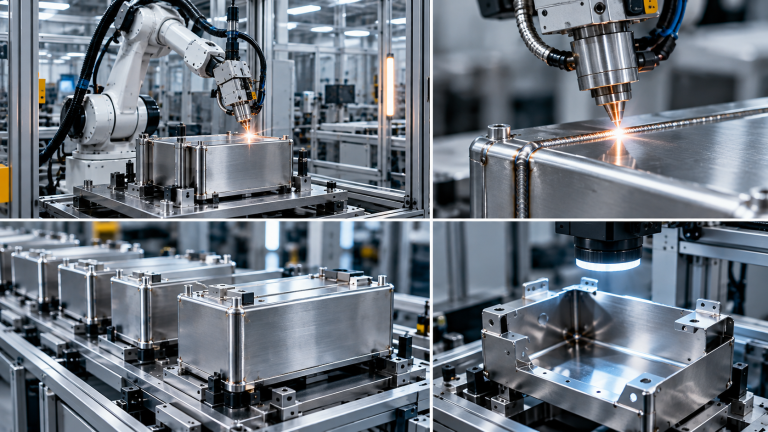
Dynalasers handheld laser welding systems are designed for concentrated heat input and can be paired with integrated wire feeding on M Series and D Series systems when filler is needed. That makes them useful for suitable thin-metal welding repair, particularly where limiting distortion matters.
That does not make laser welding the answer to every broken joint. Thick, heavily loaded, poorly accessible, or code-controlled repairs may call for a different process.
A smooth bead is reassuring, but it is not proof of a sound repair.
Check alignment, weld size, visible cracking, surrounding metal, and whether the joint actually returned to its intended position.
For critical work, visual inspection may only be the first step.
A repair should not leave every condition exactly as it was before the failure.
Maybe the surface preparation needs to improve. Maybe the joint needs more access. Maybe the filler or heat input was wrong. Or maybe the joint itself needs to carry the load differently.
In production, consistency matters just as much as one good repair. Dynalasers combines the laser source, handheld gun, gas control, and wire feeding into one system, which can make it easier to keep welding conditions stable between parts.
The point is simple: if nothing changes except the new bead, there is a good chance the same problem comes back.
Sometimes, especially on low-load parts.
Mechanical fasteners, clamps, brazing, or adhesives may be enough for certain repairs. They are not automatically equivalent to restoring a welded structural joint, though.
Not really.
Once the metals have been fused, separating them usually means removing the weld by grinding, cutting, machining, or gouging.
J-B Weld is an epoxy adhesive, not a fusion weld.
It can be useful for some light-duty repairs, but it should not be treated as a general substitute for structural weld repair.
Not necessarily.
The strength of a welded joint comes from the whole joint: weld metal, base metal, HAZ, geometry, load direction, and service conditions.
So when a weld breaks, the fracture location is evidence. It is not the entire answer.
A broken weld is usually easier to repair than it is to diagnose properly. The useful question is not only “How do I weld this back together?” but “Why did this area fail in the first place?”
For suitable thin-metal repair work, Dynalasers handheld laser welding systems offer controlled heat input and integrated wire feeding. Used in the right application, they can make the repair cleaner and easier to control, but repair quality still starts with understanding the failure.