Our Location
304 North Cardinal St.
Dorchester Center, MA 02124

304 North Cardinal St.
Dorchester Center, MA 02124

A clear guide explaining the 20 most common reasons laser welding fails. Learn how gas coverage, focus accuracy, heat control, contamination, and parameter errors affect weld quality.

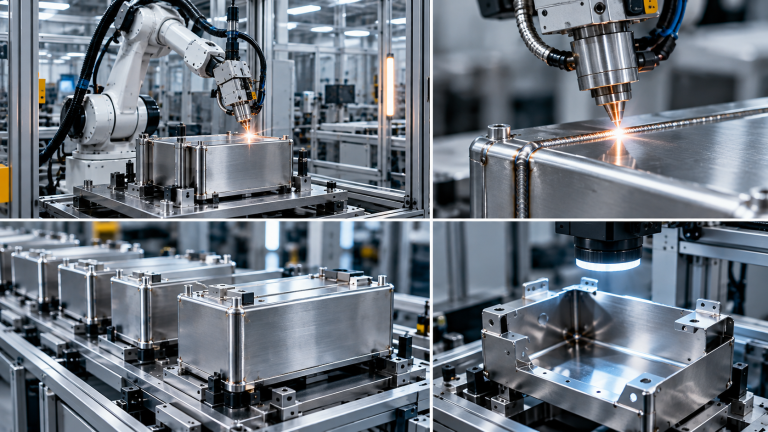
Laser welding offers high precision, minimal distortion, and excellent speed, but even the best fiber laser welding machines can produce poor results when key parameters or operating conditions are not correctly set. Understanding why laser welding fails is essential for avoiding defects, reducing rework, and improving long-term welding consistency.
Below are the 20 most common quality issues that cause laser welding failure, along with their technical explanations and corrective solutions.
Poor gas coverage is the number one cause of oxidation, black marks, and unstable weld seams, as oxygen quickly reacts with the molten pool when gas flow is too weak or misdirected. If your welds frequently turn black, improving gas direction, flow rate, and nozzle selection can significantly reduce discoloration in fiber laser welding.
Different gases change how heat and protection behave around the molten pool:
If you’re unsure which gas suits each metal, review our comparison of argon, nitrogen, and helium in laser welding.
Even if the gas is selected correctly, the angle of the nozzle may still cause the airflow to become unstable, resulting in some areas of the welding zone not being adequately protected. This problem is particularly common with handheld welding machines. If the welding gun is tilted too much, it can cause uneven gas coverage.
If the power is too high, it may cause the material to burn or overheat; if the power is too low, the welding will not be firm and the metal fusion will not be complete. The appropriate power needs to be adjusted according to the thickness of the material and its reflectivity. Therefore, finding a just-right power balance is extremely important for ensuring the welding effect.
Laser welding requires the laser energy and the moving speed to be well coordinated. That is to say, during the operation, the gun movement speed and the power need to be adjusted to an appropriate state so that the weld seam can remain stable.
Before starting the welding process, it is crucial to determine the appropriate combination of power and speed. Only in this way can the weld seam be successfully melted through.
The focus of the laser must be precisely aligned with the metal surface. Only in this way can the beam concentrate and release energy at the correct location, allowing the molten pool to form more clearly and stably.
It is extremely important to check the focus position every day, because even a slight deviation in the focal length can affect the depth of the weld, the heat distribution, and the overall effect.
When using a fiber laser for welding, the nozzle needs to be positioned close enough to achieve good gas protection, but not too close as it could cause the splatter to accumulate. If you find it difficult to control the distance, you can choose a nozzle that is more suitable for the material and joint type you are using. This will allow for a more uniform gas flow and a more stable welding result.
For more details: How to Choose the Right Laser Welding Nozzles.
If the protective lens becomes blackened or covered with dust, it will affect the quality of the light beam, which in turn may cause unstable welds or fluctuating power levels. Keeping the protective lens clean and replacing it in time when necessary can ensure the equipment remains in a stable state and prevent various problems during welding.
Oil stains, paint, rust, dust and oxide layers all affect gas protection and may also cause pores in the weld seam. Therefore, the surface must be cleaned thoroughly before welding.
If the gap between the welds is too large or uneven, the strength and quality of the weld will be affected. However, in laser welding, the closer and more uniform the seams are, the better the effect usually is.
The pulse frequency and the swing width both have an impact on the shape of the weld and the fusion effect. If the swing method is inappropriate, the weld is likely to fuse poorly and the appearance will become less uniform.
Aluminum and copper trap heat quickly, which can lead to deformation or incomplete fusion when thermal control is poor. If you often weld aluminum, techniques from how to control heat input when welding aluminum can help you manage temperature more effectively and achieve cleaner, more consistent results.
Large-sized workpieces or structures with frames may require additional cooling or fixation tools to prevent deformation. Many welding problems are actually caused by excessive heat accumulation.
For laser welding machines with wire feeding devices, the wire feeding speed must be synchronized with the state of the molten pool. If the wire feeding is unstable, the shape of the weld, the penetration depth and the overall strength will all be affected.
Only when the components are properly combined will the welding be more stable, with fewer defects and the welding quality can be more consistently maintained.
Shallow welding usually means insufficient power, moving too fast, or the focus not being properly aligned. The weld surface looks fine when it is made, but it is prone to problems when subjected to force.
During deep penetration welding, the molten channel needs to remain stable. If the molten channel collapses or fluctuates, it is prone to cause pores and the strength of the weld seam will also become insufficient.
When gases are trapped in the molten pool, gas pores will form. Common causes include:
Materials such as cast iron, high-carbon steel or hardened alloys are prone to cracking when cooled. Proper preheating and controlled cooling rates can significantly reduce the occurrence of this problem.
If the optical fiber cable is overly bent, gets dusty inside, or is operated improperly, it may cause the laser to become unstable. Moreover, damaged optical fiber cables are often one of the most costly parts to repair in the entire laser system.
Even with advanced laser welding machines, welding quality still depends heavily on operator technique:
Proper training reduces nearly all operator-related failures by helping welders recognize heat behavior, adjust parameters on the fly, and maintain stable motion, resulting in cleaner seams and fewer costly mistakes.
Laser welding fails for many reasons, but most defects come from incorrect parameters, insufficient shielding gas, wrong nozzle choice, poor heat control, or dirty optics. Once you understand these 20 common issues, you can dramatically improve welding consistency, seam appearance, and penetration stability.And if welding failure is caused by machine instability rather than technique, upgrading to a stable and air-cooled system such as Dynalasers handheld laser welding machines may be worth considering.