Our Location
304 North Cardinal St.
Dorchester Center, MA 02124

304 North Cardinal St.
Dorchester Center, MA 02124

Learn what overlap welding is, what causes weld overlap, how to identify and prevent it, and how to repair overlap defects correctly.

Overlap welding is a weld discontinuity that can look like little more than excess metal at the edge of a bead. The real concern is underneath: weld metal has extended beyond the intended weld toe or root without proper fusion to the material below.
This makes weld overlap more than a cosmetic problem. Poor fusion and an abrupt weld profile can affect inspection and fatigue performance. Good control of the weld pool is therefore important whether the work is done with conventional arc welding or a controlled process such as a Dynalasers handheld laser welding system.

What is overlap in welding? In fusion welding, overlap describes weld metal protruding beyond the weld toe or weld root. At the overlapping edge, the deposited metal lies over the adjacent surface rather than forming the intended fused transition.
A common mistake is to confuse overlap in welding with a lap joint. They are different. A lap joint describes two workpieces positioned so that one overlaps the other. An overlap welding defect describes an unwanted weld condition.
Overlap is often illustrated along the side of a weld bead, but that is not the only place it can occur. AWS interpretation discussed in industry guidance has also applied the overlap definition to weld starts and terminations. This matters during inspection because a cold-looking start or rolled-over finish should not automatically be ignored simply because it is at the end of the bead.

An overlap weld often has a lip or rolled edge where deposited metal extends onto the adjacent base material. On a fillet weld, it is usually easiest to notice around the weld toe. It can also develop at a start or stop where the weld pool was not controlled cleanly.
However, bead shape alone is not enough to make the call.
A highly convex or oversized weld is not automatically overlap. During visual inspection, the important question is whether weld metal actually extends beyond the toe or root without the required fusion. A large but properly fused bead may have poor profile or excessive reinforcement without being a true welding defect.
This distinction matters because otherwise an inspector may classify an unattractive weld as overlap when the actual issue is something else.

There is no single machine setting that explains what causes overlap in welding. It normally develops when heat input, deposition rate, travel speed, torch position, and surface condition do not allow the edge of the weld pool to fuse correctly.
Overlap is sometimes blamed simply on “too much current” or “too little current.” That is an oversimplification.
The actual problem is the relationship between heat input and the amount of metal being deposited. If there is not enough effective heat at the weld edge to melt and fuse the adjacent surface, deposited metal can flow over it instead. Excessive deposition can create a similar visible result when the weld pool becomes too large to control.
For MIG welding, voltage, wire feed, current, travel speed, and arc position therefore need to work together rather than being adjusted independently.
Slow travel is one of the most commonly cited causes of overlap in welding.
When the torch remains in one area too long, weld metal continues to accumulate. The oversized pool can flow outward past the intended toe instead of maintaining a controlled transition into the base material.
This is also why simply reducing travel speed to “get more penetration” is not always a good correction. More time in the joint does not guarantee better fusion if the weld pool becomes difficult to control.
Torch angle changes where heat and filler metal are directed.
If the arc is biased too far toward one side of the joint, the opposite edge may not receive enough effective heat for proper fusion. Gravity can make this more noticeable in horizontal and vertical welding positions, where the molten pool naturally tends to sag toward one side.
Electrode or wire size also matters. Depositing more filler than the joint and heat input can accommodate makes the pool harder to control.
Mill scale, rust, oxide, oil, paint, and other contamination can interfere with the interaction between the weld pool and the base metal.
This does not mean every contaminated weld will develop overlap, but poor preparation adds another barrier when the weld edge already has marginal heat or poor torch positioning. Cleaning the joint before welding is therefore part of overlap prevention, not merely an appearance step.
The amount of metal visible in a weld does not tell you how much of it is effectively fused. This is why a large weld overlap should not be interpreted as extra reinforcement or extra strength.
The main concerns are fusion and geometry. Metal lying over the base material without proper fusion does not contribute in the same way as sound weld metal. At the same time, a rolled or abrupt toe creates a poor geometric transition that can concentrate stress.
That becomes particularly important in components exposed to vibration or cyclic loading. Fatigue cracks tend to favor local stress concentrations, so weld-to-base-metal transition quality can matter even when the weld appears substantial.

Knowing how to prevent overlap in welding is mainly about keeping the weld pool small enough to control while still delivering sufficient energy to the joint edges. Correcting one parameter without considering the others can simply replace one weld defect with another.
Check | Practical Adjustment |
Heat input | Match current and voltage to the process, material, and joint |
Travel speed | Avoid allowing excess weld metal to accumulate |
Torch angle | Direct energy toward the areas that need fusion |
Filler delivery | Avoid depositing more metal than the pool can accommodate |
Electrode or wire | Select a suitable size for the joint |
Surface condition | Remove scale, oxide, oil, paint, and contamination |
Fit-up | Maintain consistent joint position and access |
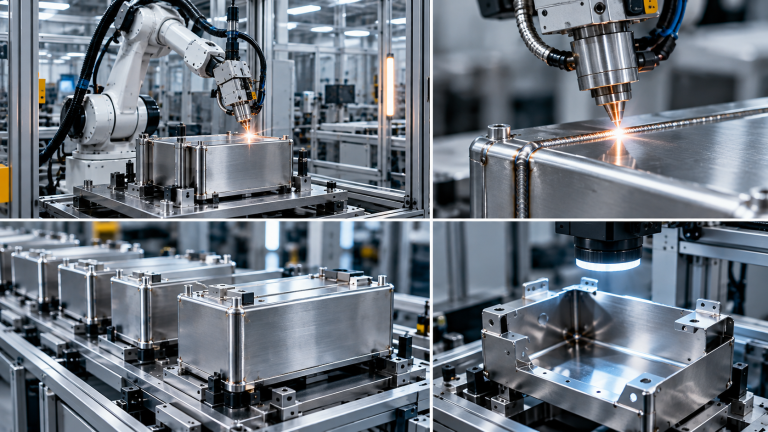
For repetitive thin-sheet work, a process with stable energy delivery can make this balance easier to maintain. Dynalasers handheld fiber laser welders combine controlled laser output with integrated wire feeding on applicable systems. This can help operators coordinate heat, movement, and filler delivery while keeping the heat-affected area relatively small.
It does not eliminate the need for correct joint preparation or technique, but better process control reduces the number of variables an operator has to fight at the weld pool.

How to fix overlap in welding depends on its extent and the acceptance requirements for the job. The important principle is that the underlying condition should be removed rather than hidden.
For a repair, the typical sequence is:
Simply depositing another bead over the overlap weld defect is a poor repair strategy. A new layer can conceal the original interface without removing the underlying fusion problem.
The repair should restore both sound fusion and an acceptable weld profile, not just make the surface look smoother.
Overlap and undercut both appear around the weld toe, so they are sometimes confused during visual inspection. The easiest distinction is to look at what happened to the material.
Feature | Overlap | |
Main condition | Weld metal extends beyond the toe without proper fusion | Base metal is melted away beside the weld |
Appearance | Rolled lip or protruding metal | Groove or depression along the toe |
Material condition | Excess deposited metal at the edge | Missing base metal |
Main concern | Fusion and stress concentration | Reduced section and stress concentration |
With undercut and overlap welding defects, the correction can therefore be quite different. Adding filler may be appropriate in some undercut repairs, while simply adding metal over an existing overlap can leave the original problem underneath.
Visual inspection is usually the first way to identify overlap. Inspectors should look closely at the weld toe and root where accessible, as well as starts and stops, rather than judging only the center of the bead.
When required by the applicable procedure or specification, surface NDT methods such as penetrant or magnetic particle testing may provide additional information about relevant surface-breaking indications around the area.
Acceptance is more complicated than saying that every visible irregularity must automatically be rejected. The applicable code, drawing, purchase specification, customer requirements, and internal workmanship standards determine what criteria actually govern the job.
An inspector should not arbitrarily apply acceptance requirements from an unrelated welding code simply because they are more stringent. If a project requires a particular standard of weld appearance or additional inspection, those requirements should be clearly established in the governing documentation.
This is especially important when deciding whether an apparent overlap defect in welding is a rejectable defect, requires repair, or needs further examination.
No. Weld overlap is an unwanted weld condition in which deposited metal extends beyond the intended toe or root without the required fusion.
Weld overlay is an intentional process. A layer of weld metal is deposited onto a surface for purposes such as corrosion resistance, wear resistance, dimensional restoration, or surface modification. Similar terminology does not make the two processes equivalent.
No. Overlapping welds or overlapping beads can be intentional in multi-pass welding, surfacing, cladding, and buildup operations. Adjacent passes may partially cover one another to create a continuous deposited layer.
The defect discussed in this article is different. It occurs when weld metal protrudes beyond the intended weld boundary without forming the required fused transition.
Not automatically. A weld being longer than the minimum length shown on a drawing does not by itself establish that a discontinuity outside the required effective length can be ignored.
Acceptance still needs to be determined from the code, drawing, project specification, inspection requirements, and other documents governing the work. If additional weld length is allowed, that does not necessarily mean any condition within that extra length is acceptable.
Overlap welding is best understood as a fusion and weld-profile problem, not simply as “too much weld metal.” Correct identification means looking at the weld toe or root, understanding how the metal fused, and distinguishing genuine overlap from a merely convex or oversized bead.
Good preparation, balanced parameters, controlled filler delivery, and consistent technique remain the main ways to prevent it. For fabrication where low heat input and repeatable control are priorities, Dynalasers handheld laser welding systems provide another option for producing controlled welds while reducing unnecessary heat and simplifying wire-fed welding on suitable applications.