Our Location
304 North Cardinal St.
Dorchester Center, MA 02124

304 North Cardinal St.
Dorchester Center, MA 02124

Learn the most common welding defects, their causes, prevention methods, inspection options, and key issues to check in laser welding.

Most welding defects start with small changes in the process. The joint may not be fully clean, the gap may vary, travel speed may drift, or the settings may no longer suit the material.
So before changing parameters, look at the weld itself. Where did the problem appear? Did it repeat? What changed from the previous good weld? Those questions often point to the cause faster than random adjustment.

A welding defect is an unacceptable condition in a welded joint that falls outside the required quality limits. Common weld defects include cracks, porosity, undercut, overlap, lack of fusion, and incomplete penetration.
Terms such as welding flaws, welding faults, and welding imperfections are also common. In general use, they overlap, although their technical meaning can differ.
A weld discontinuity is an irregularity in the weld or surrounding material. It becomes a defect when it exceeds the acceptance criteria for that part.
A small pore, for example, may be acceptable in one application but not in a joint exposed to pressure, fatigue, or high loads.
Many common welding defects first show up in the bead shape. These are usually easier to spot, although the same appearance can sometimes have more than one cause.
Defect | Typical Sign | Check First |
Undercut | Groove beside weld toe | Heat, travel speed |
Overlap | Metal rolls over weld edge | Speed, filler, fusion |
Underfill | Weld below surface | Filler, joint gap |
Spatter | Droplets around weld | Stability, contamination |
Burn-through | Hole through material | Heat, thickness |
Distortion | Part bends or warps | Heat, fixturing |

An undercut welding defect is a groove along the weld edge where base material has melted away without being filled.
Too much heat, high travel speed, or poor torch or beam position are common causes. If undercut appears mainly on one side, position may be the problem rather than overall power.
Keep the weld path steady and balance heat input with travel speed. With filler wire, check that the wire is entering the weld pool consistently.

Overlap in welding happens when molten weld metal flows onto the base material but does not fuse properly.
Moving too slowly, adding too much filler, or not getting enough effective heat at the weld edge can cause overlap.
Do not judge the fix only by bead shape. The weld edge still needs proper fusion. Speed, filler rate, and energy input should be adjusted together.

Underfill in welding means the finished weld sits below the surrounding base metal.
Too little filler is an obvious reason, but fast travel speed or a changing joint gap can give the same result.
Check fit-up first. If the gap changes along the seam, one parameter set may work in one area and fail in the next.

Spatter is molten metal that lands around the weld instead of staying in the joint.
Contamination, unstable settings, poor shielding, or inconsistent movement can all increase it.
Start with the basics: clean material, steady movement, and stable shielding. If spatter suddenly gets worse, something in the process has probably changed.

Burn-through occurs when the process melts completely through the workpiece. Thin sheet is especially sensitive.
High heat input, slow travel speed, a large joint gap, or settings meant for thicker material are common reasons.
Match the settings to the actual thickness and keep the gap controlled. When thickness changes, a short test weld is usually worth doing.

Distortion is unwanted movement or warping after welding. Excess reinforcement means the bead is higher than the joint requires.
Uneven heating, weak fixturing, poor welding sequence, or too much deposited metal can contribute.
Use only the weld volume needed. Better clamping and a more balanced welding sequence can sometimes help more than another parameter change.
Some defects in welds cannot be judged by appearance alone. A smooth bead can still hide poor fusion or shallow penetration.

Lack of fusion in welding means the weld metal has not properly bonded with the base material or another weld region.
Insufficient energy, excessive speed, contamination, poor fit-up, or incorrect heat-source position can all lead to incomplete fusion in welding.
Check the joint before simply increasing power. If the beam or arc is missing the fusion boundary, more energy may only create another problem.

Incomplete penetration in welding, or lack of penetration in welding, means the weld does not reach the intended joint root.
Penetration is about depth. Fusion is about whether adjoining surfaces actually bond.
Low energy input, excessive speed, poor root preparation, or an unsuitable gap can limit penetration.
Review joint geometry, power, and travel speed together. Too much extra energy may improve penetration but create burn-through.

Slag inclusion occurs when non-metallic material becomes trapped inside the weld.
It is mainly associated with flux-based processes and often comes from poor cleaning between passes or limited joint access.
Remove slag properly between passes and make sure the joint allows clean separation.
Slag inclusion is common in stick and flux-cored welding, but it is not a typical laser welding defect.
Some welding imperfections may appear on the surface or remain hidden. Porosity and cracks are two common examples.

Porosity is gas trapped in the weld as it solidifies. A porosity weld defect may appear as pinholes or remain inside the joint.
The causes of porosity in welding often come back to contamination or shielding. Oil, rust, moisture, coatings, or poor gas coverage can all contribute.
A contaminated weld surface is one of the first things worth checking.
Clean and dry the joint and make sure shielding gas reaches the weld properly. More gas flow is not always better if it creates turbulence.

Cracks are among the more serious welding defects because they can concentrate stress and grow during service.
Rapid cooling, residual stress, hydrogen, unsuitable material combinations, and rigid restraint can all contribute.
Keep joints clean and dry, control the thermal cycle, and use suitable filler and base materials. Some steels may also need preheating or controlled interpass temperatures.
The inspection method should match the defect. Surface checks are quick, but they cannot tell you everything about the inside of the joint.
Visual inspection can reveal undercut, overlap, underfill, surface cracks, visible porosity, spatter, burn-through, and distortion.
It is also useful to compare several welds. If the bead gradually changes from one part to the next, that may point to fit-up variation or process drift rather than one bad setting.
Common methods include:
The right method depends on the material, joint shape, and defect being investigated.
Bend tests, tensile tests, fracture tests, and macro-sections are mainly used during procedure development, qualification, or failure analysis. They can show penetration and fusion more directly than surface inspection.
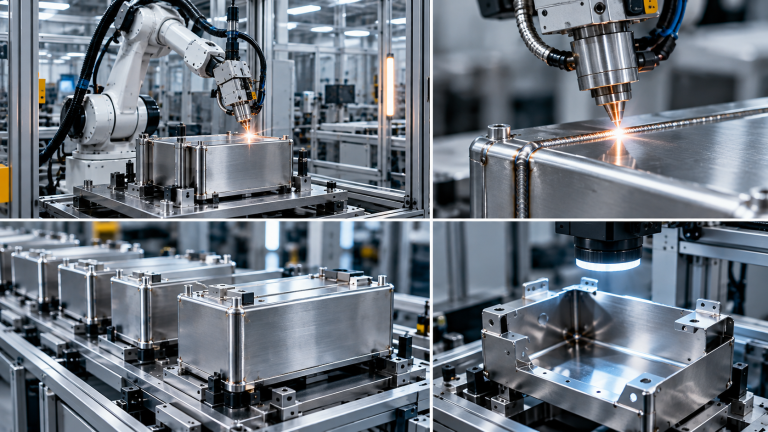
Laser welding can keep overall heat input relatively low, but weld defects still appear when fit-up, focus, speed, shielding, or power moves outside a stable range.
Defect | Check First in Laser Welding |
Porosity | Surface condition, shielding |
Lack of fusion | Power, speed, focus, fit-up |
Incomplete penetration | Power, speed, joint geometry |
Undercut | Power, speed, wobble |
Burn-through | Power, speed, thickness |
Oxidation | Shielding coverage |
With handheld laser welding, power is only one part of the setup. Joint gap, travel speed, wobble width, wire feed, focus, and shielding can all change the result.
Dynalasers handheld laser welders allow commonly used settings to be saved for repeat jobs. Those recipes are useful as a starting point, but they still need checking when the material, thickness, or joint condition changes.
Yes. Some cracks appear later as residual stresses change or hydrogen moves through the material. Certain steels may therefore need delayed inspection.
No. Repair depends on the acceptance criteria, size, location, and service requirement. Reworking an acceptable weld can introduce another heat cycle and create a new problem.
Yes. Rewelding changes the local thermal history. Poor preparation, contamination, or excessive heat can introduce cracking, porosity, or distortion.
No. Laser welding can improve repeatability, but poor fit-up, dirty surfaces, weak shielding, and unsuitable settings can still cause defects.
Most welding defects are easier to solve when you first check where the problem appears and what changed in the process. Fit-up, cleanliness, shielding, speed, and heat input usually need to be considered together.
Dynalasers gives operators flexible laser welding parameter control, but stable weld quality still starts with good preparation and a consistent process.